
Timeline: The Carlsberg Foundation through 150 years
Timeline: The Carlsberg Foundation through 150 years
1811


The founder of the Carlsberg Foundation, Jacob Christian Jacobsen – better known as J.C. Jacobsen – is born in Brolæggerstræde in Copenhagen. His mother, Caroline Frederikke Schelbeck, is the daughter of a journeyman silk weaver in Copenhagen. His father, Christen Jacobsen, is the son of a tenant farmer from Vendsyssel who moves to Copenhagen in 1801 to seek work at the Royal Brewery. In 1826, Christen Jacobsen becomes an independent brewer, establishing his own small-scale white beer brewery in Brolæggerstræde in central Copenhagen. J.C. Jacobsen is an only child, and his childhood and youth are shaped by schooling alongside work in his father’s brewery.
Brolæggerstræde and J.C. Jacobsen’s signature in the window.
1828
After completing his schooling at Bisserupske Institut, J.C. Jacobsen continues his studies independently, focusing on mathematics, history and German literature, while working in his father’s brewery. At the age of 17, he attends chemistry lectures by H.C. Ørsted, which prove highly influential for his further development. His studies are later set aside when his father falls ill and requires J.C. Jacobsen’s help at the brewery.

Drawing of the brewery in Brolæggerstræde, 1826.
1834
J.C. Jacobsen meets Laura Holst, whom he marries in 1839. Through Laura’s cousins, who study in Copenhagen, J.C. Jacobsen gains deeper insight into academic life. He attends lectures in biology and chemistry, among other subjects.

Laura Jacobsen and J.C. Jacobsen, c. 1850.
1835
J.C. Jacobsen’s father dies.
J.C. Jacobsen takes over his father’s small beer brewery in Brolæggerstræde.
1842


J.C. Jacobsen and Laura Jacobsen’s son, Carl, is born.
Carl Jacobsen, 1850 and 1854 respectively.
1846
J.C. Jacobsen is granted royal permission to build outside the city ramparts and acquires a large, well-situated site on Valby Hill, west of central Copenhagen. He begins the construction of Carlsberg, which is completed in 1847. That same year, the first beer is brewed. The brewery is named Carlsberg, after his son Carl and the hill (the old Danish word 'berg') on which the site is located.

Carlsberg, 1847.
1849
A 15,000-square-metre garden on J.C. Jacobsen’s property on Valby Hill is completed after a year of landscaping, using soil from the construction of the brewery. J.C. Jacobsen has a strong interest in botany and brings home many rare plants, trees and other vegetation from his travels across Europe, which are planted in the garden. Between 1851 and 1867, the garden is expanded to twice its original size. Nearly 160 years later, in 2008, J.C. Jacobsen’s Garden opens to the public and is listed for preservation by the Danish Agency for Culture and Palaces. In 2017, the garden undergoes extensive renovation aimed at restoring it closer to its original appearance. The renovation includes, among other things, the re-establishment of the garden’s botanical identity alongside the preservation of significant trees.

Drawing of the garden, 1883.

Early photograph of the garden, date unknown.

Early photograph of the garden, date unknown.

Drawing of the garden, date unknown.

The garden today.

The garden today.
1851
J.C. Jacobsen begins the construction of the family’s private villa on Valby Hill, which is completed in 1854. The decoration of the house is inspired by classical antiquity. He later tells his son Carl: “I have built this house, Carl, not to have a magnificent building for my residence, but in order to make something beautiful.”
Drawings of J.C. Jacobsen’s villa.
1860


J.C. Jacobsen becomes one of the first contributors to the public fundraising efforts to rebuild Frederiksborg Castle after a fire the previous year. In the years leading up to the establishment of The Museum of National History in 1878, his support grows to a total of approximately DKK 90,000.
Illustration of the castle fire published in Illustreret Tidende in 1959, and illustration of the castle after the fire, date unknown.
1875
J.C. Jacobsen establishes the Carlsberg Research Laboratory on part of his property in Valby. His aim is to develop a scientific approach to brewing in order to ensure higher and more consistent beer quality. The purpose of the laboratory is to generate new knowledge for the benefit of Carlsberg and to contribute to society through research.

The Carlsberg Research Laboratory, date unknown.

The Carlsberg Research Laboratory today.

S.P.L. Sørensen in the laboratory, date unknown.

Employees, 1904.

The building’s vestibule, date unknown.

The boardroom at the laboratory.

J.C. Jacobsen’s words inscribed on the wall of the boardroom.

Interior of the laboratory.
1876


On 25 September, J.C. Jacobsen establishes the Carlsberg Foundation through his ‘Charter and Deed of Gift’ to The Royal Danish Academy of Sciences and Letters and endows the foundation with DKK 1 million. In the brewer’s own words, the foundation is to serve “for the benefit of science and the honour of Denmark”. The purpose of the foundation is to support research in the natural sciences, mathematics, philosophy, history and linguistics, as well as the Carlsberg Research Laboratory, which the foundation also assumes responsibility for operating. J.C. Jacobsen stipulates that the foundation’s board is to consist of five members elected from among The Danish members of the Royal Danish Academy of Sciences and Letters. Today, the Carlsberg Foundation continues to support basic research across the natural sciences, the humanities and the social sciences.
1877
The Carlsberg Foundation awards its first two grants to physicist Poul la Cour, who receives DKK 1,500 to develop his phonotelegraphic system and the associated physical research, and to Kildeskriftsselskabet, which receives DKK 2,800 for the publication of ’Kancelliets Kopibog under Frederik I’.

Two of the first applications to receive funding.
1878
J.C. Jacobsen donates DKK 200,000 towards the restoration of the King’s Wing at Frederiksborg Castle on the condition that the castle is to serve as a museum of national history, intended to strengthen the public’s historical awareness and cultural understanding. In doing so, J.C. Jacobsen establishes the Museum of National History, which in the same year becomes a department under the Carlsberg Foundation.
Film clip from 1935. The Danish Film Institute
1881
Carl Jacobsen begins building the New Carlsberg brewery, which is inaugurated on 14 August 1882. To avoid confusion between Carlsberg and New Carlsberg, J.C. Jacobsen renames his brewery Old Carlsberg. In his will, J.C. Jacobsen states that his entire estate, including Old Carlsberg, is to be transferred to the Carlsberg Foundation after his death.

New Carlsberg, 1884.

Drawings of the Elephant Gate, which at the time served as the main entrance to New Carlsberg from the Valby side.

Old Carlsberg.

Beer label, 1900.

Beer label, 1897.

New Carlsberg, 1884.

1883
Emil Chr. Hansen, professor at the Carlsberg Research Laboratory, makes his groundbreaking discovery: a method for cultivating pure brewing yeast. The method is not patented but is made freely available to all.
1887


J.C. Jacobsen dies during a journey to Rome. The following year, the Carlsberg Foundation assumes ownership and operation of Old Carlsberg.
J.C. Jacobsen’s sarcophagus beneath Jesuskirken in Valby, and J.C. Jacobsen's coffin in his villa, 1887.
1897
The New Carlsberg Glyptotek at Dantes Plads opens and becomes the new home of Carl Jacobsen’s exceptional and extensive art collection. As early as 1882, he opens a small Glyptotek in Valby, but over time he transfers the collection to the City of Copenhagen, making the construction of the new museum possible.

The opening of the New Carlsberg Glyptotek, 1897.

Carl Jacobsen at the Glyptotek, 1910.

The Glyptotek, 1899.

The Glyptotek, c. 1920.

Carl Jacobsen at the Glyptotek, 1912.

The Glyptotek, date unknown.

1899
After a five-year construction period, the Carlsberg Foundation and the Royal Danish Academy of Sciences and Letters move into a palatial building at Dantes Plads. The historicist, richly decorated mansion in a classical style is built by the Carlsberg Foundation.
Headquarters, 1899.
1902
Carl Jacobsen and his wife, Ottilia Jacobsen, establish the New Carlsberg Foundation with the purpose of supporting art and art history. On the same occasion, Carl Jacobsen transfers the brewery New Carlsberg to the Carlsberg Foundation. As a result, the two breweries now share a common owner.

Carl and Ottilia Jacobsen. Painting: Julius Paulsen, 1924
1909


Professor S.P.L. Sørensen invents the new unit of measurement pH at the Carlsberg Research Laboratory, making it possible to describe how acidic or alkaline a substance is.
S.P.L. Sørensen, date unknown, and S.P.L. Sørensen (front right) with his team, date unknown.
1911
Carl Jacobsen’s mother, Laura Jacobsen, dies.

Laura Jacobsen, date unknown.

1913
Carl Jacobsen donates The Little Mermaid, which later becomes a symbol of Copenhagen.

1914
Carl Jacobsen dies.
1914
Laura and J.C. Jacobsen’s villa serves as an honorary residence. In his will from 1882, J.C. Jacobsen stipulates that, after the death of his closest relatives, the villa, garden and greenhouse are to be made available to a man or woman engaged in science, literature or the arts. Over the following eight decades, the residence is home to five scholars and their families. One of the residents is Niels Bohr, who lives in the residence from 1931 to 1962.

The philosopher Harald Høffding becomes the first resident.


Niels Bohr lives in the residence with his wife, Margrethe, from 1931 to 1962.


In 1967, the Danish astronomer Bengt Strömgren is offered the residence, marking his return to Denmark after a long research career in the United States.

The Pompeii-hall.

1961
On the occasion of J.C. Jacobsen’s 150th birthday, the Carlsberg Foundation donates a building to serve as a new home for the Accademia di Danimarca in Rome – today known as the Danish Academy in Rome.


The Accademia di Danimarca is designed by architect Kay Fisker.
1970
Carlsberg and Tuborg merge to form United Breweries A/S (DfB), and all five members of the Carlsberg Foundation’s board become members of the new company’s board.

The negotiations are concluded on 25 May 1970. Seated around the table in one of the classrooms of the Royal Danish Academy of Sciences and Letters, the Tuborg representatives are on the left and the Carlsberg representatives on the right. Photo: Carlsberg Archive
1991
The Tuborg Foundation, which is established in 1931, becomes a department under the Carlsberg Foundation. Today, the Tuborg Foundation supports young people aged 16-30 in creating a sustainable future, with a focus on Democracy, Working Life, Green Transition, and Rhythmic Music.
1995


The last resident in J.C. Jacobsen's former villa dies. The Carlsberg Foundation decides that the residence is henceforth to be used for scientific conferences and symposia and to bear the name ‘Carlsberg Academy’. The ground floor is dedicated to events and activities, while the first floor is to serve as a residence for a distinguished visiting international scholar. Following a restoration, the Carlsberg Academy is completed in 1997.
Søren Egerod, 1993. He is the last resident. The residence is subsequently used for scientific conferences and symposia.
2001
At the Carlsberg Research Laboratory, chemist and professor Morten Meldal and his PhD student Christian Tornøe accidentally discover a copper-catalysed reaction that later proves crucial to the development of so-called click chemistry. In 2022, Morten Meldal receives the Nobel Prize in Chemistry for this discovery.

Morten Meldal in the laboratory.
2007
The statutes of the Carlsberg Foundation are amended so that the foundation is henceforth required to hold at least 25 per cent of the share capital in Carlsberg A/S. At the same time, the foundation must continue to hold shares representing at least 51 per cent of the voting rights.
2011
The Carlsberg Foundation Research Prizes are established on the occasion of the 200th anniversary of the birth of the foundation’s founder, J.C. Jacobsen. The prizes aim to support two active researchers in Denmark or abroad who have made decisive contributions to basic research and who enjoy wide scientific recognition.
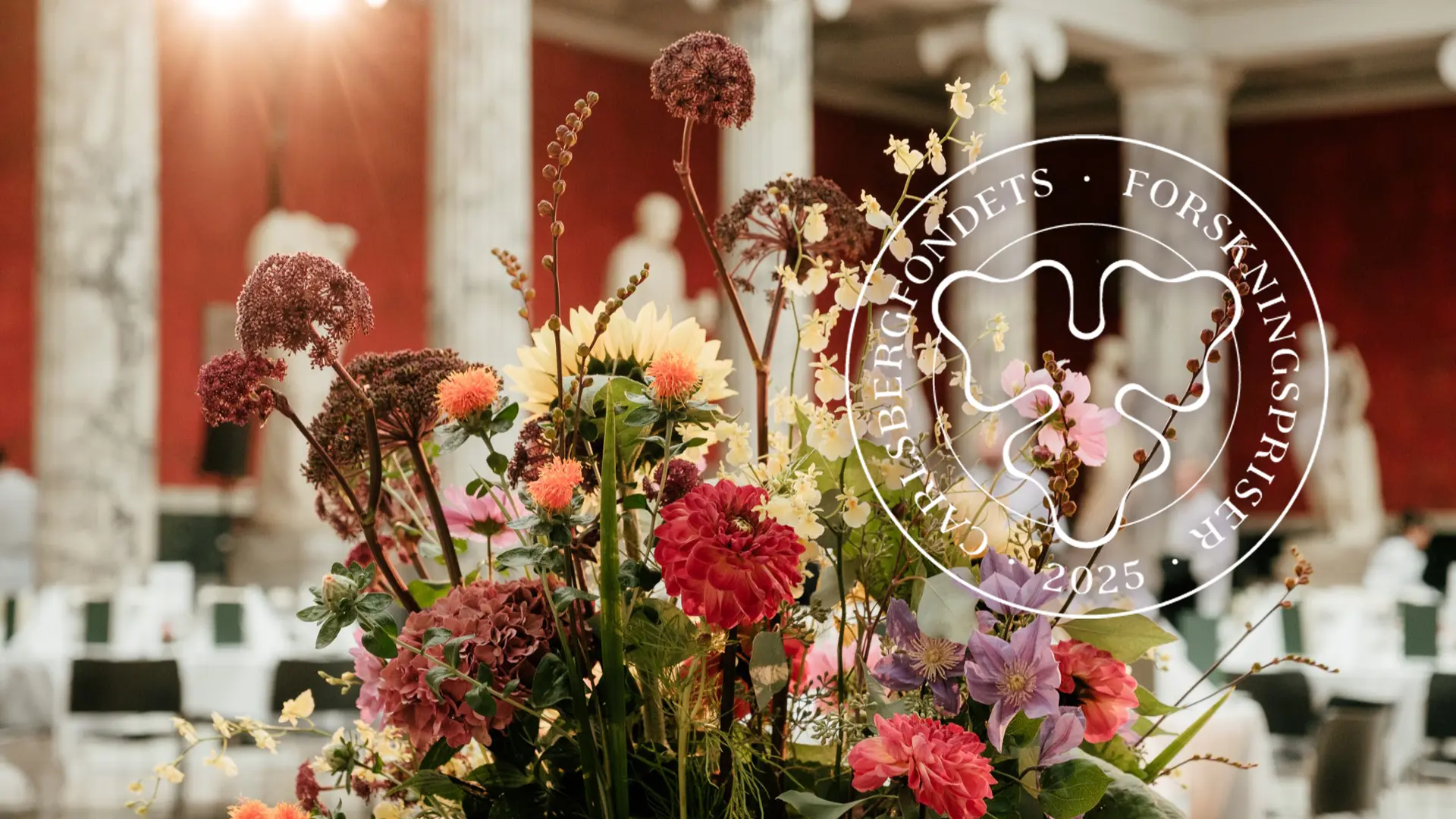
The Carlsberg Foundation Research Prizes are awarded in the Glyptotek’s Central Hall.

The Glyptotek’s Central Hall. Foto: Martin Juul

The Winter Garden on the evening of the award ceremony. Photo: Malthe Ivarsson.

The Central Hall. Foto: Malthe Ivarsson
2013
The requirement to hold a specific share capital stake is abolished. The foundation is nevertheless required to retain a shareholding corresponding to at least 51 per cent of the voting rights, thereby maintaining controlling influence.
2015
Queen Margrethe II's Roman Prize is established by the Carlsberg Foundation. The purpose of the prize is to recognise and strengthen research conducted at, or in affiliation with, the Danish Academy in Rome.
2016
The Carlsberg Foundation's researcher apartments in Carlsberg Byen are inaugurated and brought into use. The development, which is designed to accommodate researchers from Denmark and abroad, receives several awards, including the Danish Association of Architects’ ‘Store Arne Prize’ and a diploma from the Association for the Beautification of the Capital.

Photo: Jens Lindhe
2019
The Carlsberg Academy undergoes extensive restoration, refurbishment and technical upgrading. The ambition of the renovation is to return the building to its original appearance from the mid-19th century, when brewer J.C. Jacobsen built the villa. The work takes place in two phases, in 2019–2021 and 2022–2024.
Photo: Karina Tengberg og Anders Sune Berg
2022
The Carlsberg Foundation changes its governance structure so that only two of the foundation’s five board members are represented on the board of Carlsberg A/S. This brings to an end the practice dating back to 1970, under which all five members of the foundation’s board also served on the brewery’s board. The provision stipulating that the Chair of the Foundation automatically also serves as Chair of Carlsberg A/S is likewise amended.
From 2022 onwards, the Chair of the Foundation serves as Vice Chair of Carlsberg A/S, while the second board member is appointed from among the foundation’s five board members based on relevant competencies. The purpose is to strengthen good corporate governance and ensure a more modern and diverse board composition at Carlsberg A/S.
2023
The Carlsberg Foundation appoints its first CEO. This decision is made with the ambition of future-proofing the foundation organisationally and strengthening its engagement with the foundation’s external relations.

2023
The visitor centre Home of Carlsberg opens in Carlsberg Byen. Today, the exhibition presents the history and legacy of both the Carlsberg Foundation and the Carlsberg Family.
J.C. Jacobsen’s beer cellar can also be experienced at the museum. Photo: Daniel Rasmussen
